Poor roof ventilation causes attic heat buildup, mold growth, premature shingle aging, and skyrocketing energy bills. Common roof ventilation problems include blocked soffit vents, insufficient exhaust vents, and imbalanced airflow. In hot climates like Albuquerque, NM, these issues are more severe and require prompt professional attention.
Your attic might be quietly destroying your roof right now and you’d never know it.
Most homeowners think about ventilation only when something visibly breaks. A ceiling stain here. A spike in the electricity bill there. But by the time those signs appear, the underlying damage from poor roof ventilation has often been building for months, sometimes years.
Roof ventilation isn’t a luxury feature. It’s the system that keeps your attic temperature regulated, your moisture levels balanced, and your shingles from aging before their time. When it fails, the consequences ripple through your entire home.
We’ve inspected hundreds of roofs across New Mexico and roof ventilation problems are among the most consistently overlooked issues we find. This post breaks down what poor ventilation looks like, why it hits harder in Albuquerque’s climate, and what you can do about it before the damage becomes costly.
What Is Poor Roof Ventilation—and Why Does It Matter?
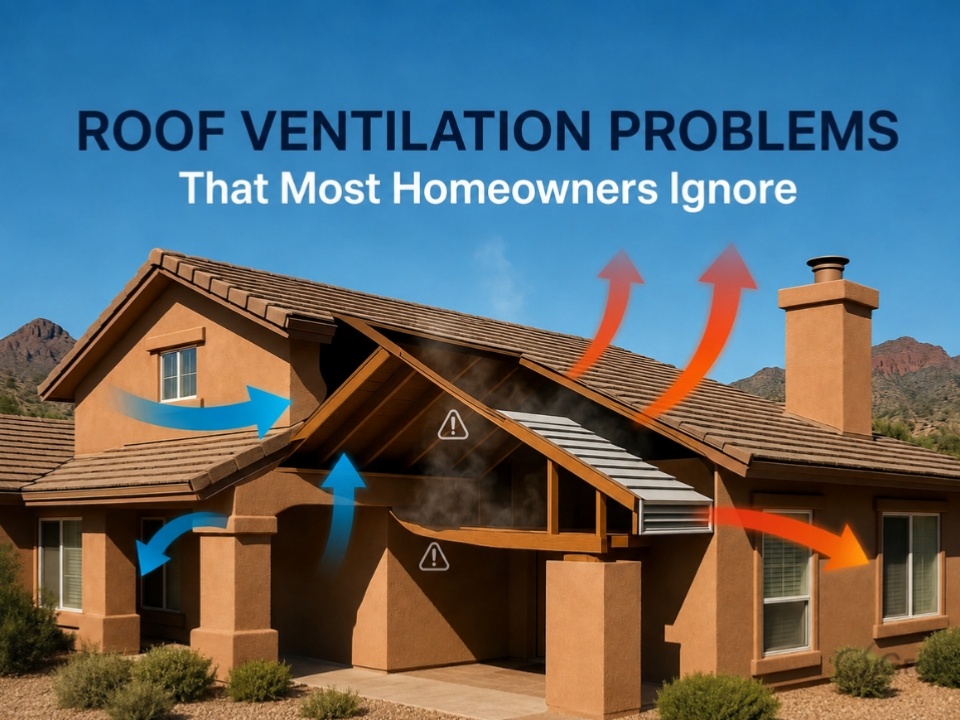
A properly ventilated roof works through a simple intake-and-exhaust system. Cool, fresh air enters through soffit vents at the base of your roof. Hot, moisture-laden air exits through ridge vents or other exhaust vents at the peak. This continuous airflow keeps attic temperatures stable and prevents moisture from accumulating on your roof decking.
When that system breaks down—due to blocked vents, improper installation, or inadequate vent coverage—heat and humidity have nowhere to go. The attic turns into a pressure cooker. Temperatures can exceed 150°F in summer. Moisture condenses on wood and insulation. The entire structure starts to deteriorate from the inside out.
One widespread misconception is that ventilation only matters in cold climates because of ice dams. In reality, attic ventilation problems in hot climates are equally destructive—just in different ways. High heat accelerates shingle degradation, strains your HVAC system, and creates conditions ripe for mold growth even without high humidity.
What Are the Signs of Poor Roof Ventilation?
Why does my attic feel like an oven in summer?
An attic that’s uncomfortably hot to enter or that makes the rooms directly below it feel stuffy is one of the clearest signs of poor attic ventilation. Without adequate exhaust vents, solar heat absorbed by your roof has nowhere to escape. In Albuquerque, where summer temperatures regularly exceed 100°F, an inadequately ventilated attic can reach temperatures well above what’s safe for your roofing materials.
Can poor attic ventilation cause high energy bills?
Yes. When your attic absorbs and retains extreme heat, that heat transfers into your living space. Your air conditioner works harder and longer to compensate, driving up your monthly energy costs. A home in Albuquerque with bad attic ventilation can see a measurable increase in cooling costs during summer months.
How does poor ventilation damage shingles?
Asphalt shingles are designed to be heated from one side the exterior. When heat builds up in a poorly ventilated attic, shingles bake from both directions simultaneously. The result: premature curling, cracking, and granule loss. Shingles that should last 25 to 30 years may fail in 15. This is one of the most common roofing problems New Mexico homeowners face, and it’s almost always linked to ventilation.
Other warning signs to watch for
- Musty smells or visible mold in the attic: Trapped moisture creates the perfect environment for mold and mildew. If you notice a musty odor coming from your attic, bad attic ventilation is a likely cause.
- Peeling paint or warped wood inside the home: Attic moisture doesn’t stay in the attic. It works its way into walls and ceilings, causing paint to bubble and wood to warp.
- Water stains on attic ceiling or roof decking: Attic condensation on roof decking is a direct sign that moisture isn’t escaping properly.
- Pest infestations: Warm, undisturbed attic spaces attract insects and rodents. Poor ventilation worsens this by creating consistently warm conditions year-round.
What Are the Most Common Roof Ventilation Problems?
Blocked soffit vents
Soffit vents are the intake portion of your ventilation system and they’re frequently blocked by insulation that’s been pushed too far toward the eaves, or by debris and paint during renovations. A blocked soffit vent starves the entire system of fresh air, reducing the exhaust vent’s effectiveness even if that component is working perfectly.
Insufficient or wrong type of exhaust vents
Ridge vents, static vents, and powered attic ventilators each have their strengths and appropriate applications. Using too few vents, or choosing the wrong type for your roof’s pitch and size, leaves your attic underventilated. A common mistake is installing a powered attic ventilator alongside a ridge vent—the powered unit can actually pull conditioned air from the home rather than from the attic, wasting energy.
Imbalanced intake-to-exhaust ratio
Proper attic airflow depends on a near-equal balance of intake and exhaust capacity. Too much exhaust and not enough intake creates negative pressure, pulling conditioned air from inside your home. Too much intake and not enough exhaust and hot air stagnates near the roof peak. Both scenarios compromise the system’s effectiveness.
Improperly installed vents
Roof vent problems often stem from installation errors rather than product failures. Vents placed too close together, installed without proper flashing, or positioned in ways that allow wind-driven rain to enter can cause more harm than having no vents at all. This is especially common in older homes or after DIY roofing work.
Attic ventilation issues specific to hot and desert climates
In high-desert environments like Albuquerque, the combination of intense UV radiation, extreme summer heat, and low humidity creates specific challenges. While low humidity reduces the risk of condensation compared to coastal climates, the temperature differentials between day and night can still create attic moisture issues. More critically, the sheer intensity of the heat puts disproportionate stress on shingles and roof decking—making proper ventilation even more essential here than in milder climates.
Why Roof Ventilation Problems Are Especially Severe in New Mexico
Albuquerque sits at over 5,000 feet in elevation, with a high-desert climate that brings intense solar radiation, summer temperatures frequently over 100°F, and dramatic temperature swings between day and night. This environment creates a unique set of roof ventilation challenges.
During summer, an unventilated attic in Albuquerque doesn’t just get hot—it becomes a heat reservoir that radiates warmth into your living spaces for hours after the sun goes down. The prolonged heat exposure accelerates the breakdown of roofing materials at a rate faster than in more temperate climates.
In New Mexico’s dry climate, some homeowners assume that moisture isn’t a concern. That’s a mistake. While humidity is generally lower than in coastal states, cooking, showering, and daily living still generate moisture vapor that rises into the attic. Without proper exhaust ventilation, that moisture accumulates. Combined with extreme temperature swings, it can cause attic condensation on roof decking, leading to wood rot and structural weakness over time.
New Mexico roofing problems caused by poor ventilation tend to escalate quickly because the climate provides no mild seasons to slow the damage. Addressing attic ventilation in Albuquerque, NM isn’t a matter to delay.
How to Fix Poor Roof Ventilation: Practical Solutions
Start with a professional roof inspection in New Mexico
Before making any changes, get an accurate picture of your current system. A qualified roofing contractor in Albuquerque can assess your intake-to-exhaust ratio, identify blocked vents, and flag any installation errors. Altitude Roofing offers comprehensive ventilation assessments across New Mexico.
Clear blocked soffit vents
If insulation has migrated toward your eaves, install rafter baffles (also called vent chutes) to keep the insulation back and maintain a clear airflow channel. Remove any debris or paint blocking vent openings.
Add or upgrade exhaust vents
Ridge vents are generally the most effective exhaust solution for sloped roofs because they run the entire length of the roof peak, providing continuous and evenly distributed airflow. If your home currently uses static box vents, upgrading to a continuous ridge vent can significantly improve attic airflow.
For homes with complex roof structures or large attic spaces, a solar-powered attic ventilator can supplement passive venting without adding to your energy bill.
Correct your intake-to-exhaust balance
The general building code guideline is 1 square foot of ventilation for every 150 square feet of attic floor space, split evenly between intake and exhaust. A roofing professional can calculate whether your current setup meets this standard and recommend the right number and placement of additional vents.
Address roof vent repair in Albuquerque promptly
Damaged or deteriorating vents should be repaired or replaced before the next summer season. Cracked vent covers, missing flashing, and corroded screens are easy fixes that prevent much larger problems. Roof vent repair in Albuquerque, NM is a straightforward job for an experienced contractor—don’t let it sit.
What Are the Real Benefits of Fixing Your Roof Ventilation?
Solving your roof ventilation problems delivers measurable, lasting advantages:
- Lower energy bills: A properly ventilated attic reduces heat transfer into your living space, cutting the load on your air conditioning system.
- Extended roof lifespan: Shingles and roof decking last significantly longer when they’re not exposed to excessive heat from below.
- Improved indoor comfort: Upper-floor rooms stop feeling like saunas in summer.
- Moisture and mold control: Balanced airflow prevents the humidity buildup that enables mold growth.
- Building code compliance: Most local codes require specific ventilation ratios. Proper ventilation keeps your home compliant and insurable.
A homeowner in Albuquerque who consulted Altitude Roofing about an overheated attic and mold growth found that installing a combination of ridge vents and soffit vents improved indoor air quality noticeably and reduced their energy bills by approximately 20%.
For more detail on how different ventilation systems work for specific roof types, see our guide on the best ventilation for felt roofs.