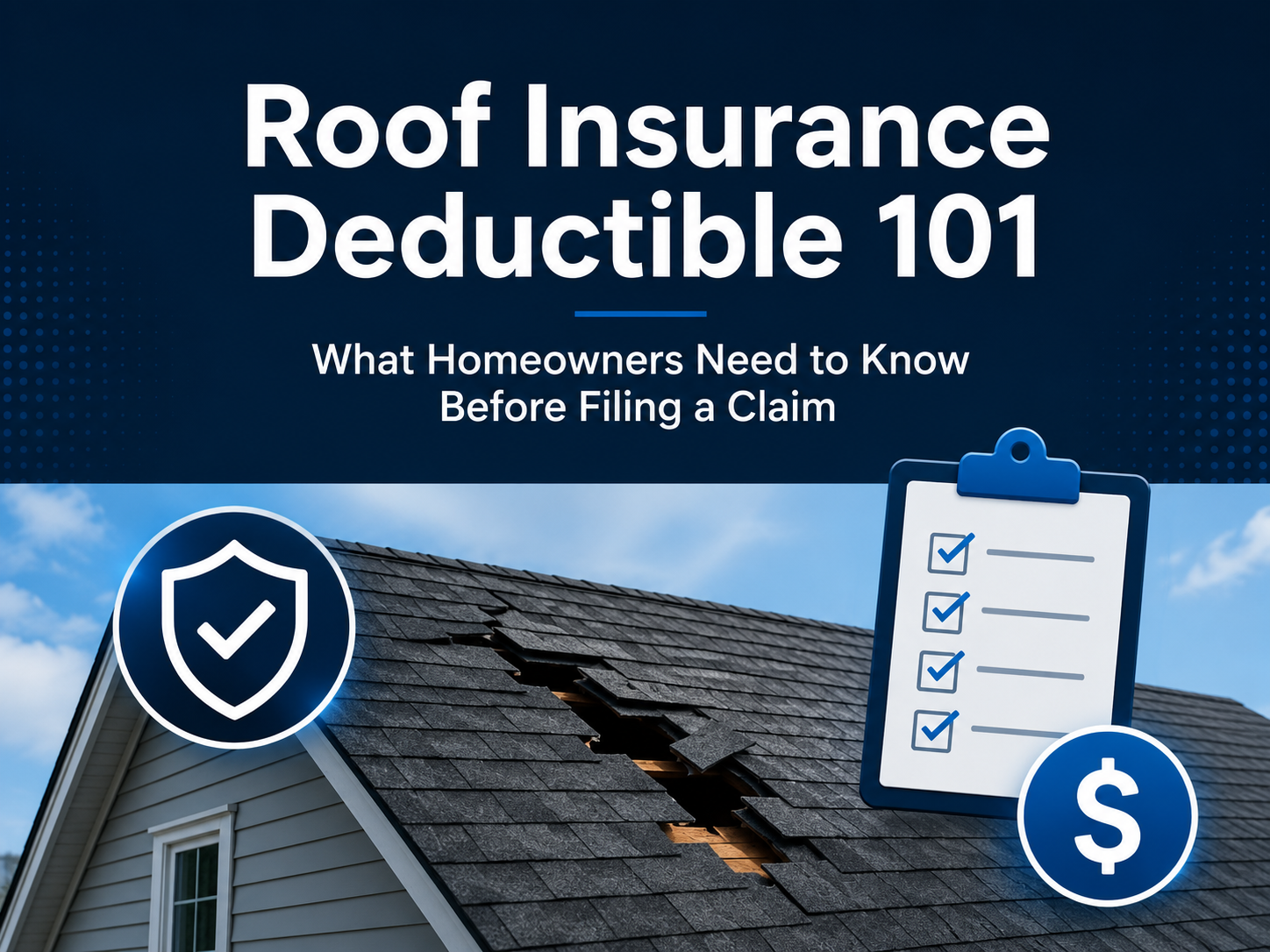
A roof insurance deductible is the amount you pay out of pocket before your homeowner’s insurance covers the rest of a roofing claim. You typically pay this amount directly to your roofing contractor not your insurance company after your claim is approved and repair work begins.
Most homeowners only think about their roof insurance deductible when a storm rolls through and shingles start flying. By then, it’s too late to understand the fine print. Whether hail has just punched holes in your roof or a wind event has peeled back your flashing, knowing how your roof deductible works before you file a claim can save you from financial surprises—and costly mistakes.
This guide breaks down everything you need to know: how roof insurance deductibles work, who you actually pay them to, what happens if you can’t afford yours, and what red flags to watch for when working with roofing contractors.
What Is a Roof Deductible in Homeowners Insurance?
A roof deductible is the fixed amount or percentage of your home’s insured value that you’re responsible for paying before your homeowner’s insurance steps in to cover roof damage. It’s not a penalty it’s a cost-sharing mechanism built into every standard homeowners insurance policy.
Here’s a simple example: if your roof replacement costs $12,000 and your deductible is $2,000, your insurance company pays $10,000 and you cover the remaining $2,000.
Deductibles come in two main forms:
- Flat deductibles: A fixed dollar amount (e.g., $1,000 or $2,000) applied to any claim regardless of the total repair cost.
- Percentage-based deductibles: Calculated as a percentage of your home’s insured value, typically ranging from 1% to 5%. On a home insured for $300,000, a 2% deductible means you’d pay $6,000 out of pocket before coverage kicks in.
Percentage-based deductibles are increasingly common for weather-related claims especially hail and wind damage in storm-prone states like New Mexico.
How Much Is a Roof Insurance Deductible?
The average roof insurance deductible varies widely based on your policy type, insurer, and location. Flat deductibles typically fall between $500 and $2,500. Percentage-based deductibles often range from 1% to 5% of your home’s dwelling coverage.
Some insurers apply separate, higher deductibles specifically for named perils like hailstorms or hurricanes. If you live in an area prone to severe weather, check your declarations page carefully you may have a standard deductible for most claims and a higher wind or hail deductible on top of that.
To find your specific deductible amount, look at your insurance declarations page or contact your insurance agent directly before filing a claim.
How Does a Roof Insurance Deductible Work, Step by Step?
Understanding the roof replacement insurance claim process helps you avoid surprises and move faster when damage occurs.
Step 1: Document the damage
After a storm event, photograph all visible roof damage from the ground—don’t climb on a damaged roof. Note the date of the storm and any interior damage caused by leaks.
Step 2: Contact your insurance company
File your roofing insurance claim promptly. Most policies have time limits on storm damage claims, and delays can complicate your case.
Step 3: Insurance adjuster inspection
Your insurer will assign an insurance adjuster to inspect the roof. The adjuster determines the scope of damage and estimates the repair or replacement cost. You have the right to have a roofing contractor present during this inspection—and in many cases, it’s a smart move.
Step 4: Review your claim settlement
Once the adjuster submits their report, your insurer will issue a claims decision. This document outlines the total approved amount, your deductible, and whether payment is based on Actual Cash Value (ACV) or Replacement Cost Value (RCV).
- ACV (Actual Cash Value): Pays the depreciated value of your roof based on its age and condition at the time of damage.
- RCV (Replacement Cost Value): Pays the full cost to replace your roof with materials of like kind and quality, without depreciation deductions.
RCV policies typically pay in two installments: an initial ACV payment, then a supplemental check (called “recoverable depreciation”) once the work is complete and verified.
Step 5: Pay your deductible to your contractor
After your claim is approved and you’ve selected a licensed roofing contractor, the contractor completes the work. Your deductible is paid directly to your roofing contractor—not to your insurance company. The insurer then pays the contractor the remaining approved balance.
Who Do You Pay Your Roof Deductible To?
This is one of the most commonly misunderstood aspects of filing a roof claim. You do not send your deductible payment to your insurance company. Instead, you pay your roof deductible directly to your roofing contractor as part of the total project cost.
Think of it this way: your insurance company pays their share, and you pay yours both going to the contractor who does the work.
Do You Pay Your Deductible Before or After Roof Repair?
Typically, the deductible is paid at or around the time repair work is completed, though payment timing can vary by contractor. Some roofing contractors request the deductible upfront before beginning work; others collect it at project completion alongside the insurance payout. Clarify this with your contractor before signing any agreement.
Can a Roofer Waive or Pay Your Insurance Deductible?
No and this is critical. In most U.S. states, including New Mexico, it is illegal for a roofing contractor to waive, absorb, or rebate your insurance deductible. This practice is considered insurance fraud, and it exposes both the homeowner and the contractor to serious legal and financial consequences.
If a contractor offers to “cover your deductible” or says you won’t have to pay it, treat that as a significant red flag. Reputable contractors don’t make this offer because they legally can’t.
What Happens If You Can’t Pay Your Roof Deductible?
Struggling to cover your deductible is more common than most homeowners admit especially when percentage-based deductibles result in four- or five-figure out-of-pocket costs. Here are legitimate options:
- Payment plans: Many licensed roofing contractors offer financing or installment arrangements.
- Personal loans or home equity lines: Can be used to cover the gap while you manage cash flow.
- Savings or emergency funds: Ideally, your emergency fund should account for your deductible amount.
- Negotiate the scope with your insurer: If you disagree with the adjuster’s estimate, you may be able to request a re-inspection or hire a public adjuster to advocate on your behalf.
What you should never do is attempt to inflate your claim to offset the deductible. This constitutes insurance fraud and can result in policy cancellation or criminal charges.
Does Filing a Roof Claim Raise Your Insurance Rates?
Filing a roofing insurance claim can raise your premium, depending on your insurer, your claims history, and the type of damage. Weather-related claims (like hail or wind) tend to have less impact on premiums than claims attributed to maintenance neglect, since the former is outside your control. Some insurers offer claim forgiveness for first-time or weather-related claims check your policy or ask your agent before filing.
Does Homeowners Insurance Cover Full Roof Replacement?
Whether insurance covers a full roof replacement depends on the cause of damage, your policy type, and your roof’s age.
Coverage is generally available for:
- Hail damage
- Wind damage
- Fire
- Falling objects (e.g., tree branches)
Coverage is typically not available for:
- Normal wear and tear
- Aging or deterioration
- Improper installation or lack of maintenance
- Flood damage (typically requires separate flood insurance)
Older roofs may be subject to depreciation schedules, meaning your ACV payout could be significantly lower than the actual replacement cost. Some insurers also cap coverage for roofs over a certain age. Review your policy carefully to understand your homeowners insurance roof coverage limits before damage occurs.
Can You Negotiate a Roof Insurance Settlement?
Yes—homeowners have the right to dispute or negotiate their insurance settlement if they believe the adjuster’s estimate is inaccurate or incomplete. Steps you can take include:
- Get a written estimate from a licensed roofing contractor to compare against the adjuster’s scope of work.
- Request a re-inspection if significant damage was overlooked.
- Hire a public adjuster, who works on your behalf (for a percentage fee) to negotiate a higher settlement.
- File a complaint with your state’s insurance commissioner if you believe the insurer is acting in bad faith.
Document everything throughout this process photos, written communications, and contractor estimates all serve as evidence.